Complete all 6 sections to master the four macromolecules of life!
⏱ Time spent:0:00
Take your time — no rush! Suggested ~35 minutes
0 of 6 sections complete
📚 Section 1: Vocabulary Matching⏱ ~5 min
Match each macromolecule term with its correct definition.
Monomer
Single small building-block molecule (e.g., amino acid, monosaccharide)
Polymer
Large molecule made of many repeating monomer subunits
Dehydration Synthesis
Reaction that links monomers by removing a water molecule
Hydrolysis
Reaction that breaks polymers apart by adding water
Peptide Bond
Covalent bond between the amino group of one amino acid and carboxyl group of another
Phospholipid
Lipid with a hydrophilic head and two hydrophobic fatty acid tails
Nucleotide
Building block of DNA/RNA: sugar + phosphate group + nitrogenous base
Disaccharide
Sugar formed when two monosaccharides join (e.g., sucrose, lactose, maltose)
🔬 Section 2: Key Figures⏱ ~6 min
Study these key OpenStax figures covering all four macromolecule types. Click each to reveal its description.
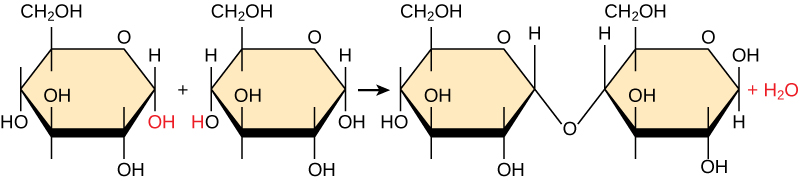
Figure 3.2Dehydration synthesis: Two glucose molecules link to form maltose (a disaccharide). A water molecule is removed in the process. This is how all polymers are built — monomers join as water leaves.
🔍 Click to reveal
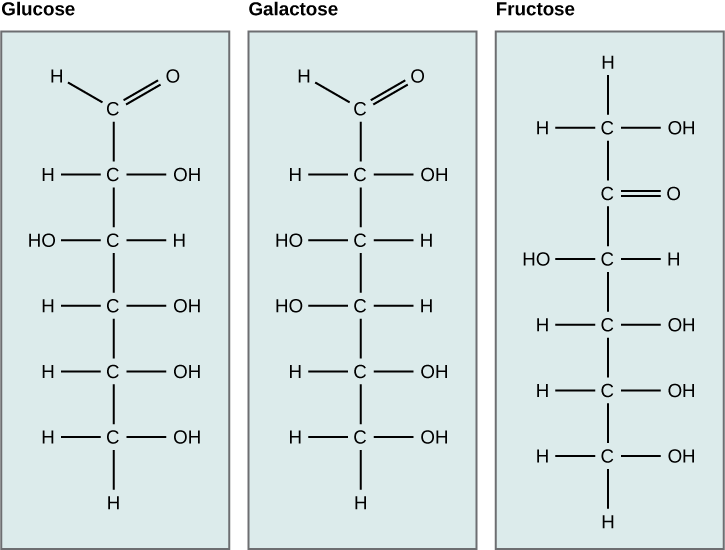
Figure 3.5Glucose, galactose, and fructose are all hexoses (C₆H₁₂O₆) but are structural isomers — same formula, different arrangement of atoms. This demonstrates that structure determines function in biology.
🔍 Click to reveal
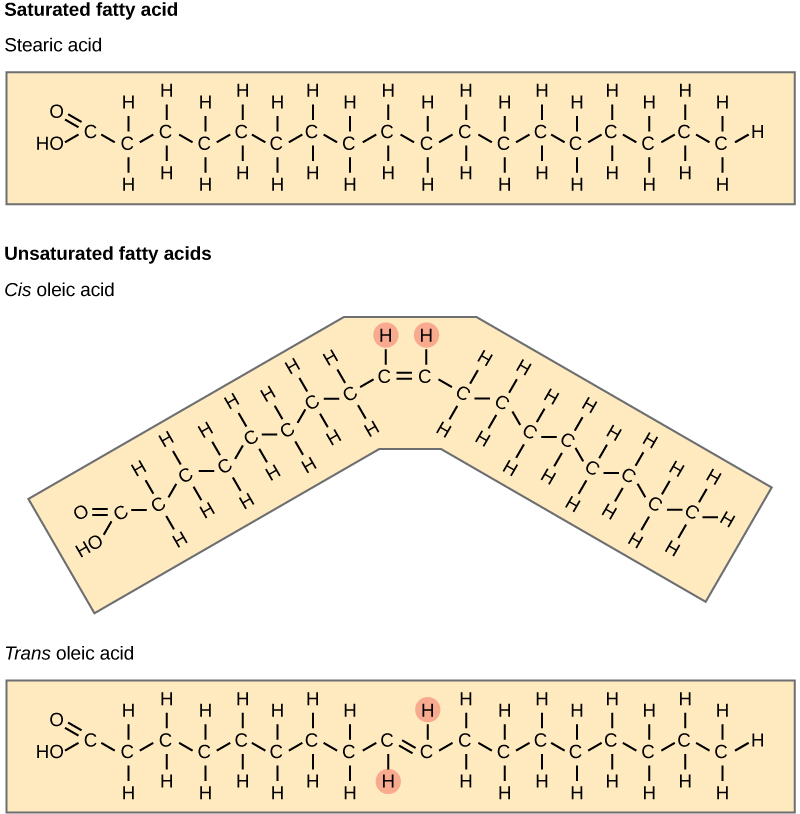
Figure 3.16Saturated fatty acids have only single bonds between carbons (straight, solid at room temp). Unsaturated fatty acids have one or more double bonds causing kinks (liquid at room temp, like oils).
🔍 Click to reveal
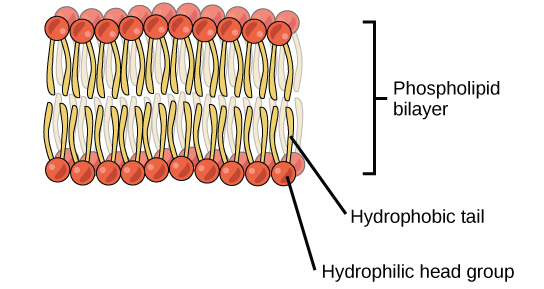
Figure 3.20The phospholipid bilayer is the major component of all cell membranes. Hydrophilic phosphate heads face the water on both sides, while hydrophobic fatty acid tails face inward, away from water. This creates a selectively permeable barrier.
🔍 Click to reveal
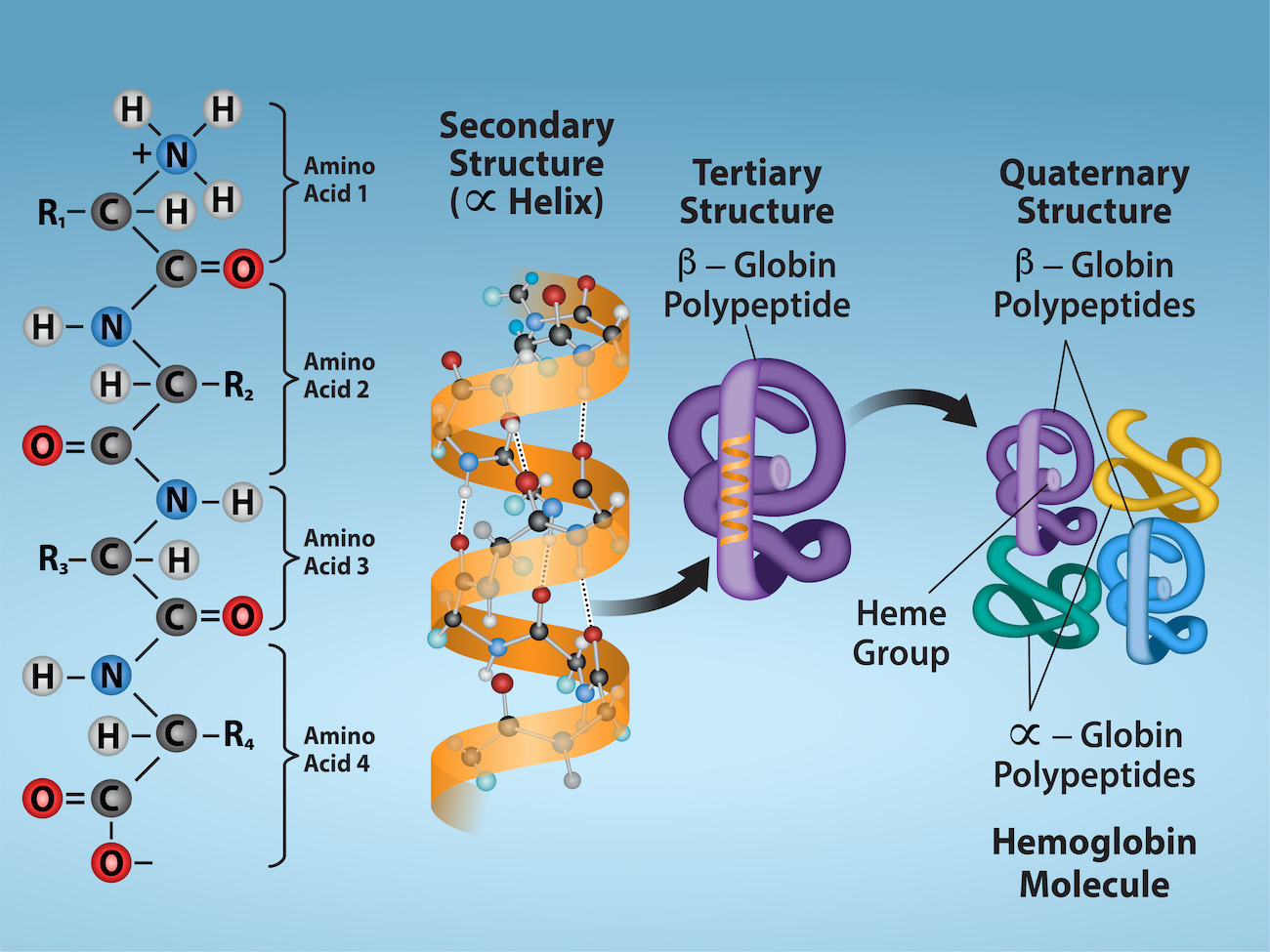
Figure 3.30Four levels of protein structure: (1) Primary — amino acid sequence, (2) Secondary — α-helices and β-pleated sheets from H-bonding, (3) Tertiary — 3D folding from R-group interactions, (4) Quaternary — multiple polypeptide subunits joined together.
🔍 Click to reveal
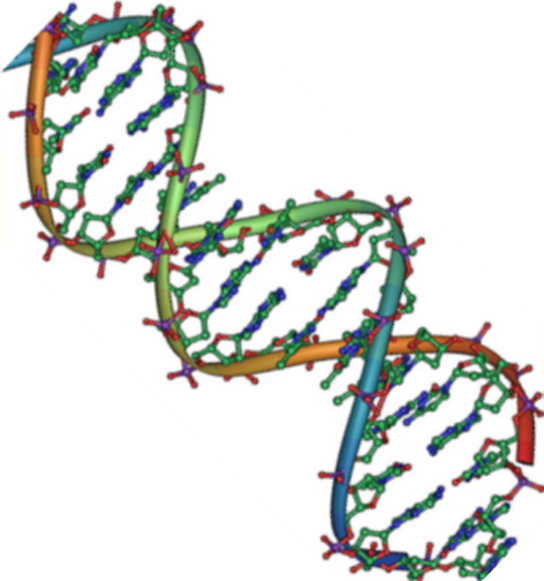
Figure 3.32DNA is an antiparallel double helix. The sugar-phosphate backbone runs in opposite directions (5'→3' and 3'→5'). Complementary base pairs (A-T, G-C) are connected by hydrogen bonds in the center. This structure allows DNA replication and information storage.
🔍 Click to reveal
🔄 Section 3: Sort the Macromolecules⏱ ~5 min
Click each item below to assign it to the correct macromolecule category. Select a chip, then click the correct category.
🍞 Carbohydrates
🧈 Lipids
🥩 Proteins
🧬 Nucleic Acids
Click an item, then click a category above:
Glucose
Triglyceride
Hemoglobin
DNA
Cellulose
Phospholipid
Enzyme
mRNA
Starch
Cholesterol
Amino acid chain
Nucleotide
✅ Section 4: Concept Check⏱ ~8 min
Test your understanding of the four macromolecules.
Rate your confidence on biological molecules:
1. What type of reaction links monomers together to form a polymer?
Hydrolysis
Dehydration synthesis (condensation)
Oxidation
Fermentation
Look at the diagram — what small molecule is released when two glucose molecules bond?
Why this is correct: Dehydration synthesis (also called condensation) removes a water molecule to form a covalent bond between two monomers. This is how glucose → maltose, amino acids → proteins, and nucleotides → DNA are all built. Hydrolysis is the reverse — it breaks bonds by adding water.
2. Why do unsaturated fats tend to be liquid at room temperature?
They have more carbon atoms than saturated fats
They contain nitrogen atoms
They dissolve in water more easily
Double bonds create kinks that prevent tight packing
Compare the shapes in the diagram — straight chains vs. kinked chains. Which can pack together more tightly?
Why this is correct: The cis double bonds in unsaturated fatty acids create kinks in the hydrocarbon chains. These kinks prevent the molecules from packing tightly together, so they remain liquid (oils) at room temperature. Saturated fats with straight chains pack tightly, forming solids (like butter).
3. Which level of protein structure is determined by the specific amino acid sequence?
Quaternary structure
Tertiary structure
Primary structure
Secondary structure
Think about what comes "first" in protein folding — before any 3D shape forms...
Why this is correct: Primary structure is the linear sequence of amino acids in a polypeptide chain, determined by the gene that codes for it. This sequence dictates all higher levels of structure: secondary (α-helices, β-sheets), tertiary (3D folding), and quaternary (multi-subunit assembly). A single amino acid change can alter the entire protein (like in sickle cell disease).
4. What is the difference between DNA and RNA?
DNA is double-stranded with deoxyribose; RNA is single-stranded with ribose
DNA contains amino acids; RNA contains nucleotides
DNA is found only in mitochondria; RNA is in the nucleus
DNA uses uracil; RNA uses thymine
"Deoxy" means one fewer oxygen. And think: which base does RNA use instead of thymine?
Why this is correct: DNA is double-stranded with deoxyribose sugar and uses bases A, T, G, C. RNA is single-stranded with ribose sugar (has one more -OH group) and uses A, U, G, C (uracil replaces thymine). DNA stores genetic information; RNA helps express it (mRNA, tRNA, rRNA).
5. What is the function of the phospholipid bilayer?
To store genetic information
To form a selectively permeable barrier around cells
To provide energy for cellular processes
To catalyze chemical reactions
The hydrophilic heads face water while hydrophobic tails hide inside. What kind of barrier does this create?
Why this is correct: Phospholipid bilayers form cell membranes — selectively permeable barriers that control what enters and exits the cell. The hydrophilic heads face the aqueous environment while hydrophobic tails form the interior, blocking polar/charged molecules while allowing small nonpolar molecules through.
💡 Section 5: Apply Your Knowledge⏱ ~5 min
Answer these short response questions (minimum 30 characters each).
Question 1
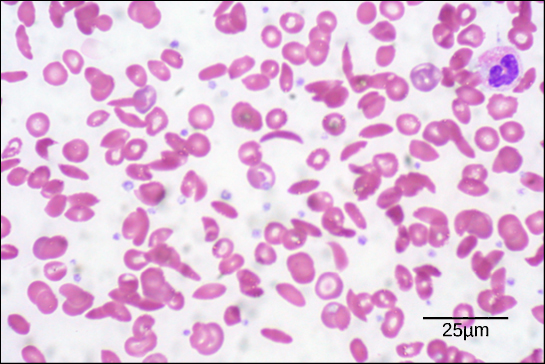
Sickle cell disease is caused by a single amino acid change in hemoglobin (glutamic acid → valine). Using your knowledge of protein structure, explain why this small change can have such a dramatic effect.
0 / 500
Question 2
Why can humans digest starch (from bread and potatoes) but not cellulose (fiber from vegetables), even though both are made of glucose?
0 / 500
🎯 Section 6: Final Reflection⏱ ~2 min
Write a brief reflection: Why is understanding biological macromolecules important for understanding all of biology? How do the four types work together in a living cell? (Minimum 100 characters)
0 / 1000
🧬
Study Guide Complete!
Outstanding work! You've mastered the building blocks of life.